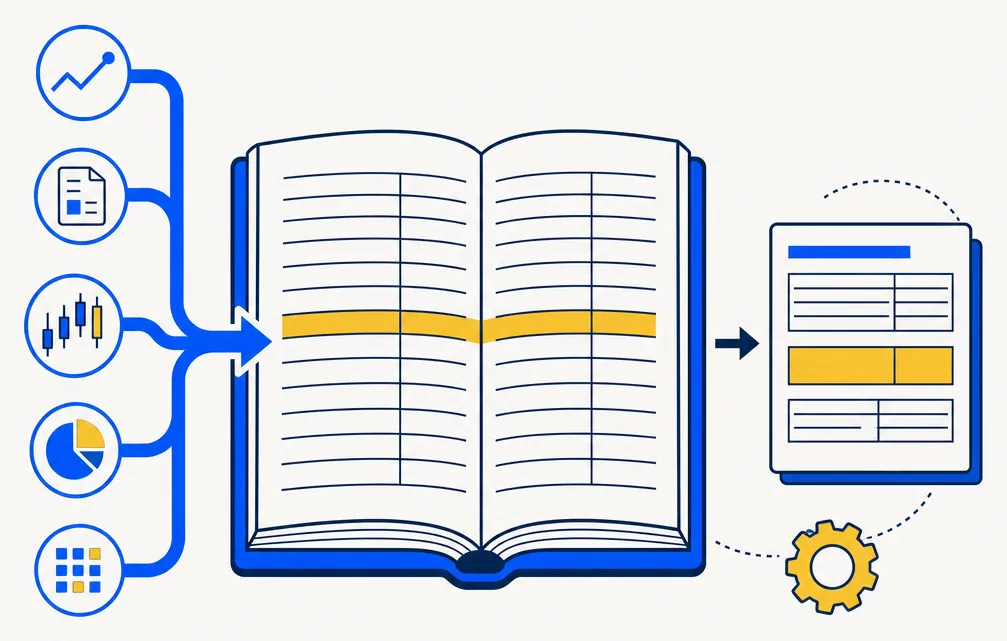
Selling a stock at a loss and capturing the tax value is one half of a harvest transaction. The other half is telling the IRS about it accurately. Every capital transaction — gains and losses alike — flows through IRS Form 8949 before landing on Schedule D. Understanding the form's structure is what separates a harvest that is cleanly filed from one that invites follow-up questions.
This walkthrough covers the mechanics: which part of the form a harvested loss lands in, what the three basis-reporting columns mean, why wash-sale adjustments appear as code W, and how to handle the multi-lot "Various" dates that tax-loss harvesting software routinely produces.
What is Form 8949 and why does every capital transaction require it?
What is IRS Form 8949 and why is it required for tax-loss harvesting transactions?
IRS Form 8949, "Sales and Other Dispositions of Capital Assets," is the transaction-level detail schedule where each individual capital sale — including every tax-loss harvested lot — is reported line by line; those per-lot figures aggregate into Schedule D, which carries the combined capital gain and loss total onto Form 1040.
Schedule D shows the IRS the net result of capital transactions for the year. Form 8949 is the source detail that Schedule D summarizes. Each equity sale — including a tax-loss harvest — requires a separate line entry on Form 8949. Each line captures: the description of the property, the acquisition date, the sale date, the sale proceeds, the cost basis, any required adjustments (including wash-sale disallowances), and the resulting gain or loss.
An investor who harvests twenty positions in a year may have twenty or more Form 8949 lines depending on how many lots each sale covers. The form has been required in its current format since 2012 (Rev. Proc. 2011-58), when Congress expanded basis-reporting requirements for brokers under the Emergency Economic Stabilization Act of 2008. Before that expansion, brokers reported only proceeds; investors were responsible for computing and reporting their own basis.
Part I vs Part II: where do short-term and long-term harvested losses land?
How does Form 8949 separate short-term capital losses from long-term capital losses, and where do tax-loss harvested lots typically appear?
Form 8949 is divided into Part I (short-term transactions — assets held one year or less) and Part II (long-term transactions — assets held more than one year); a harvested loss lands in Part I if the sold lot was held twelve months or fewer, and in Part II if held longer — a distinction that matters because short-term losses offset short-term gains first, potentially at a higher combined effective rate.
The term of a harvested lot is determined from the acquisition date of the specific lot sold — not the average holding period of the position or the date the account was opened. A position held for three years may still contain individual short-term lots if shares were recently added through dividend reinvestment or a separate purchase.
This is where lot selection method intersects with Form 8949 reporting. When specific-ID lot selection designates which shares are sold, the acquisition date of those specific shares determines the Part I or Part II assignment. The IRS requires that the designation happen before settlement (Treas. Reg. §1.1012-1(c)); the lot's term is fixed from that point.
Many tax-aware investors prefer to harvest short-term losses when available — short-term losses offset short-term gains (typically taxed at ordinary income rates) before they offset long-term gains, which can make them potentially more immediately valuable. The annual pacing article walks through how this plays out across a tax year.
Columns A, B, and C: what basis-reporting status means for harvested lots
What do the three checkboxes (A, B, and C) on Form 8949 indicate about basis reporting, and which one applies to standard brokerage-reported harvests?
Form 8949's three checkboxes indicate whether the broker reported the transaction's cost basis to the IRS — Box A or D means broker-reported proceeds and basis (covered securities); Box B or E means broker-reported proceeds but not basis; Box C or F covers all other transactions — and for most equity positions acquired after 2011 at a US broker, Box A (short-term) or Box D (long-term) applies because basis reporting became mandatory for "covered" securities under EESA 2008.
Each page of Form 8949 uses one set of three checkboxes at the top, and all transactions on that page must match that box. A typical return for an active tax-loss harvesting program may have multiple pages: one for short-term covered securities (Box A), another for long-term covered securities (Box D), and possibly additional pages if the investor holds any pre-2012 "non-covered" positions or transferred assets whose basis was not carried over.
The distinction matters practically because the IRS cross-checks broker-reported figures (Box A and D) against its own 1099-B data. For most harvesting programs focused on equities purchased after 2011 at a major US broker, virtually all positions are covered securities and land in Box A or Box D without additional complexity.
Adjustment code W: how wash-sale disallowances appear on Form 8949
How does a wash-sale disallowance appear on Form 8949, and what does the code W adjustment mean for the reported loss amount?
When a sale triggers a §1091 wash-sale disallowance, the disallowed portion of the loss appears on Form 8949 as a positive number in column (g) "Adjustment to gain or loss" with a "W" entered in column (f) "Adjustment code" — effectively reducing or eliminating the deductible loss on that line while the disallowed amount is added to the cost basis of the replacement security rather than permanently forfeiting it.
The mechanics work as follows: suppose a lot is sold at a realized loss of approximately $800, but approximately $500 of that loss is disallowed because a substantially identical security was purchased within the 30-day window before or after the sale. The Form 8949 line would show approximately $800 in the loss column, a positive approximately $500 adjustment in column (g), and "W" in column (f). The net deductible loss on that line is approximately $300.
The approximately $500 disallowed amount is not permanently lost — it is added to the cost basis of the replacement security, deferring the tax benefit until the replacement is eventually sold. The IRS basis-adjustment mechanic is described in IRC §1091(d) and Publication 550.
The wash-sale rule demystified article covers the underlying rule in detail. For investors using direct indexing, the substantially identical deep dive explains how the IRS defines the triggering condition across ETFs and sector substitutes.
HarvestEngine's optimization engine is §1091-aware: it checks a configurable wash cooldown window before surfacing any candidate sell, and it tracks open buy orders and recent purchases to avoid inadvertent wash triggers.
From Form 8949 to Schedule D: the rollup and the loss carryforward
How do Form 8949 totals flow into Schedule D, and what happens when total capital losses exceed capital gains in a given year?
Each Form 8949 section's net total is copied to the corresponding line on Schedule D, which combines short-term and long-term totals to produce the net capital gain or loss for the year; when total capital losses exceed total capital gains, up to $3,000 of the net loss may be deducted against ordinary income annually, with any remaining excess carrying forward indefinitely to future tax years under IRC §1212.
The up-to-$3,000 annual ordinary income deduction limit (unchanged since 1978) is a binding constraint for investors with large harvested-loss banks. It is also what makes a large loss bank valuable over a long horizon: losses carry forward without dollar-amount expiration and can absorb future realized gains at full value when a meaningful exit or rebalancing event occurs.
The netting order matters for planning purposes. Net long-term capital losses offset long-term gains first, then short-term gains. Net short-term losses offset short-term gains first, then long-term gains. An investor who prefers to preserve long-term gains taxed at the lower long-term rate may find that a year with large short-term losses provides a different net benefit than expected when those losses net against long-term gains rather than equivalent-rate income.
For a full treatment of how harvested losses can be deployed across multiple years, the annual pacing article walks through carryforward mechanics in detail.
For a full treatment of how harvested losses can be deployed across multiple years, the annual pacing article walks through carryforward mechanics in detail.
Read this next with lot selection methods, the wash-sale rule, annual TLH pacing, and the substantially identical deep dive.