Medicare premiums are often described as a fixed cost of coverage — the same standard rate for every beneficiary. The Income-Related Monthly Adjustment Amount, or IRMAA, disrupts that picture. For beneficiaries whose modified adjusted gross income exceeds the standard threshold, Medicare Part B and Part D premiums step up in graduated tiers — sometimes substantially — adding hundreds or thousands of dollars per year to the cost of coverage.
Capital gains events play a direct role. A large rebalancing trade, a concentrated stock liquidation, or a Roth conversion executed in a high-income year may push MAGI across an IRMAA bracket boundary and trigger premium surcharges that last for a full calendar year. Because IRMAA operates on a two-year income lookback, these decisions cascade: income recognized in 2024 determines Medicare premiums in 2026.
The connection to tax-loss harvesting is the same mechanism at work in the NIIT: both surcharges respond to net capital gains. Harvested losses that reduce realized capital gains reduce MAGI directly — and may reduce IRMAA exposure in the coverage year that follows. For the federal surcharge that works on a continuous formula rather than stepped tiers, see the NIIT and TLH.

What is IRMAA, and who may be subject to it?
What is the Income-Related Monthly Adjustment Amount and which Medicare beneficiaries may owe it?
IRMAA is an income-based surcharge that the Social Security Administration may add to standard Medicare Part B and Part D premiums for beneficiaries whose modified adjusted gross income from two years prior exceeds annually adjusted thresholds — applied in graduated steps so that higher income brackets face progressively larger premium increases.
IRMAA was established under the Medicare Prescription Drug, Improvement, and Modernization Act of 2003, with thresholds refined by subsequent legislation including the Affordable Care Act. The SSA applies the adjustment each year using MAGI data reported to the IRS two years earlier. The standard Medicare Part B premium — approximately $185 per month in recent years — is the base; IRMAA surcharges layer on top, potentially adding roughly $70 to approximately $440 per month per person depending on income tier and coverage year. Part D IRMAA surcharges apply similarly to prescription drug coverage, though the specific amounts differ.
Single filers may encounter the first IRMAA tier when MAGI exceeds approximately $106,000, a level that investment income and capital gain events can push above more easily than many beneficiaries anticipate. Married filing jointly thresholds are approximately double the single-filer thresholds at each tier. All specific dollar amounts are subject to SSA's annual CPI-based adjustment — the Social Security Administration publishes the current-year schedule in the Federal Register each fall, and beneficiaries receive written IRMAA determinations from SSA before the coverage year begins.
How do capital gains affect MAGI for IRMAA purposes?
Do capital gains increase the modified adjusted gross income that determines IRMAA surcharges?
Yes — both long-term and short-term capital gains are included in MAGI for IRMAA purposes under the same income definition used for most federal tax computations, and a single large capital gain event can push a beneficiary across one or more IRMAA tier boundaries.
MAGI for IRMAA purposes is essentially adjusted gross income with certain deductions added back — it does not deduct standard or itemized deductions. Capital gains from the sale of appreciated securities, real estate, or other investment property flow through AGI and therefore through MAGI in the year they are recognized. A one-time event — liquidating a concentrated position, executing a large rebalancing trade, or converting a traditional IRA to Roth — can create a MAGI spike in that year that the SSA picks up two years later when determining the subsequent coverage year's premiums.
The bracket structure of IRMAA makes the marginal effect of a gain particularly pronounced near a threshold. If MAGI sits just below the first IRMAA tier, a realized gain that pushes it above can trigger a surcharge on the entire year's Part B and Part D premiums — not just on the income above the threshold. This cliff structure is unlike marginal income tax brackets, which only apply the higher rate to income above the threshold. Managing MAGI near an IRMAA boundary therefore involves somewhat different planning logic than managing marginal tax rates generally. For the income-based surcharge that operates on a continuous formula rather than stepped tiers, see the NIIT and TLH.
How does the two-year lookback affect timing decisions?
Because IRMAA is based on income from two years earlier, how does the timing of capital gains and harvested losses affect Medicare premium planning?
Income recognized in the current year determines Medicare Part B and Part D premiums two years later — so a tax-loss harvest that reduces net capital gains in the current year reduces MAGI for that year, which the SSA uses to set premiums in the coverage year that follows.
For a beneficiary already enrolled in Medicare, this creates a planning horizon that extends beyond the current tax year. If 2024 income includes a large capital gain event, the IRMAA impact appears in 2026 premiums — a determination made from 2024 tax data after most year-end tax planning is complete. Harvesting losses in 2024 that reduce net capital gains in that year may reduce 2026 IRMAA exposure, even if the harvest decision was originally driven by other tax considerations.
For investors approaching Medicare eligibility, the two-year window makes the years immediately before enrollment particularly relevant. An unusually high-gain year two years before enrollment may set premiums above the standard rate from the first month of coverage. Harvesting losses in portfolio years that happen to include large realized gains may therefore carry a dual benefit: reducing current-year capital gains taxes and potentially avoiding a higher IRMAA tier in the first years of Medicare coverage.
The SSA does provide a life-changing event exception — beneficiaries who have experienced a qualifying event (retirement, marriage, divorce, death of spouse, loss of income-producing property) may request that the SSA use more recent income data than the standard two-year lookback. Ordinary capital gain events and investment portfolio decisions do not qualify as life-changing events; the two-year lookback applies in those cases.
Can tax-loss harvesting reduce IRMAA exposure?
Can harvesting capital losses reduce the MAGI that determines IRMAA tiers, and how material may the benefit be?
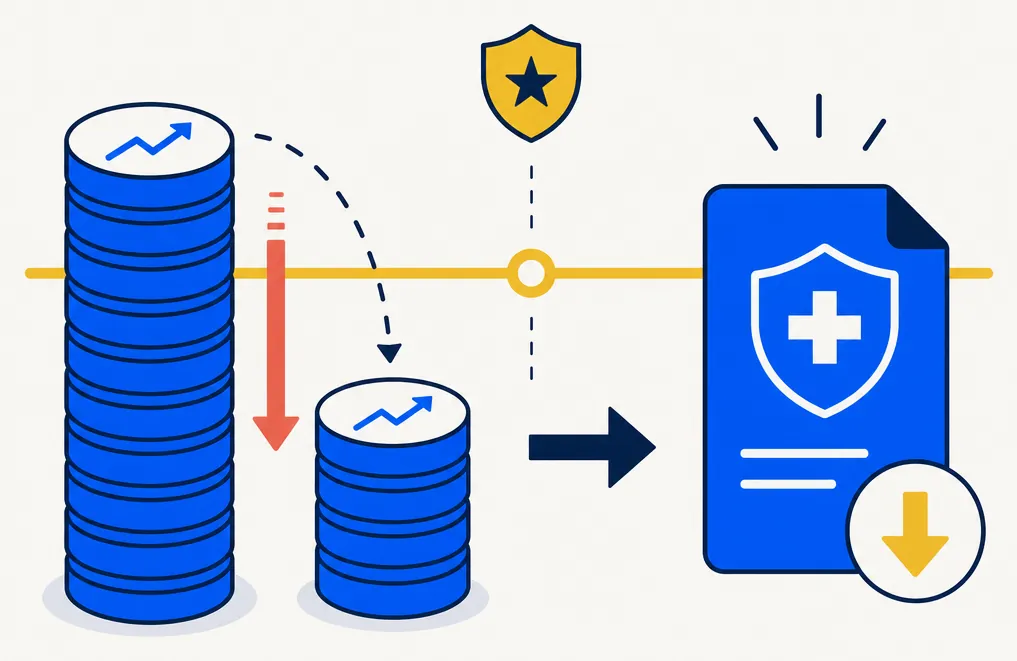
Harvested capital losses that offset capital gains reduce MAGI directly, and if that offset brings MAGI below an IRMAA tier boundary, the resulting premium saving may persist across the full Medicare coverage year — potentially amounting to roughly $840 to approximately $5,300 per person annually depending on which tier is crossed and the current SSA schedule.
The mechanism is direct: capital losses reduce net capital gains, which reduces AGI, which reduces MAGI. For a Medicare-enrolled beneficiary whose MAGI sits near an IRMAA threshold primarily because of capital gain events, harvesting enough losses to bring MAGI below the tier boundary can potentially eliminate the surcharge for the entire coverage year associated with that income year. The full-year nature of the saving matters: IRMAA is determined annually, so reducing MAGI enough to drop a tier in a single income year can produce a premium benefit that runs across twelve months of coverage.
The benefit may compound when a spouse is also enrolled in Medicare. IRMAA is assessed per beneficiary, with both spouses' surcharges determined from the same joint MAGI figure (for married filing jointly filers). A household with two Medicare-enrolled beneficiaries may potentially see roughly double the per-person premium saving if both are affected by the same tier reduction. Because the loss carryforward provisions of IRC §1212 allow unused losses to carry into future years, harvesting in advance of a known gain event may position a loss bank to reduce MAGI in the event year. For how carryforwards accumulate and persist, see capital loss carryforwards.
HarvestEngine's realized-loss tracking maintains per-lot loss records that feed the harvest opportunity analysis. The engine surfaces the current carryforward balance alongside harvest candidates, which provides the MAGI offset information relevant to IRMAA planning — though the specific premium impact depends on individual enrollment circumstances and the current SSA schedule.
Coordinating IRMAA, the NIIT, and TLH across the same tax year
For an investor subject to both IRMAA and the NIIT, how do harvested losses potentially interact with both surcharges in a single tax year?
Harvested losses that reduce net capital gains may reduce NIIT exposure in the harvest year and IRMAA exposure in the coverage year two years later — two distinct federal surcharges that both respond to net capital gains, meaning each harvested dollar can potentially carry a combined benefit that spans the regular capital gains rate, the approximately 3.8% NIIT, and the IRMAA premium differential.
The NIIT and IRMAA use overlapping but distinct income concepts. The NIIT under IRC §1411 applies to net investment income — which includes capital gains but excludes wages and retirement distributions — and may trigger at approximately $200,000 MAGI for single filers under current law. IRMAA applies to the broader MAGI figure, which includes wages and most other income, with its first surcharge tier starting lower than the NIIT threshold. A Medicare-enrolled investor with substantial wage income plus capital gains may find that capital gains push MAGI across an IRMAA threshold even in a year when NIIT exposure exists at a different level of the income stack.
For a tax year in which a large gain event occurs — concentrated stock liquidation, property sale, or Roth conversion — harvesting losses in other portfolio positions may simultaneously reduce the NIIT base in that year and the MAGI that determines IRMAA surcharges two years later. The gain-offset planning discusses deploying a loss bank against large gain events; the same loss bank that offsets a gain for NIIT purposes in year one also reduces MAGI for IRMAA purposes in the coverage year that follows. For the broader framework of stacking multiple tax-offset strategies in the same year, see tax alpha explained.
Read this next with the NIIT and TLH, capital loss carryforwards, Roth conversions and TLH, tax alpha explained, and gain-offset planning.