
Most investors think of their taxable account as one thing: "my portfolio." A better model is to think of it as layers, each doing different work with different tax consequences.
If you read institutional materials from firms like Gotham, you will see a close cousin of this architecture: a broad beta sleeve paired with an overlay. HarvestEngine adapts that thinking for self-directed investors by breaking the problem into three sleeves: beta, long, and optional short.
The three sleeves
What are the three sleeves in a tax-aware portfolio structure?
A tax-aware portfolio separates into three functional layers: a beta sleeve of broad-market ETFs for passive exposure, a long direct-index sleeve where individual-stock TLH happens, and an optional short overlay for advanced risk management.
| Sleeve | Holdings | Purpose | TLH role |
|---|---|---|---|
| Beta | Broad-market ETFs like VOO, VTI, IXUS, BND, or AGG | Cheap, efficient market exposure | Limited harvest surface, but excellent tracking and simplicity |
| Long | Direct-index sleeve of single stocks tracking an index | Keep benchmark exposure while creating lot-level flexibility | The main TLH engine, because each stock can be harvested independently |
| Short | Optional short positions in names not held long | Expand the overlay and reshape risk without selling appreciated longs | Can create additional harvest surface, but adds margin, borrow, and tax complexity |
Why split the portfolio at all
Why does separating a taxable portfolio into distinct sleeves create better outcomes than managing it as one pool?
The sleeves solve different problems — clean passive exposure, tax-lot-level harvest flexibility, and optional advanced overlay — and mixing those problems into one undifferentiated pool makes each harder to manage.
- Beta is the clean exposure layer. If you want exact, low-friction market exposure, broad ETFs are hard to beat.
- Long is the tax-aware layer. It gives you dozens of tax lots instead of one ETF position.
- Short is the advanced overlay. It is optional. It can be useful. It is not free and it is not for everyone.
This is why a portfolio can be both simple and sophisticated at the same time. The simplicity sits in the beta sleeve. The sophistication sits in the overlay logic.

What public institutional materials teach
What structural lesson do institutional TLH programs like Gotham's offer for self-directed investors?
One of the more useful takeaways from Gotham's public materials is structural, not magical: separate broad market exposure from the overlay that is trying to add tax efficiency or alpha.
In Gotham's case, the public description is an S&P 500 ETF base sleeve plus a market-neutral long/short overlay.
That does not tell you their secret sauce. It does not reveal the ranking model, the exact optimizer, or the exact lot-level trigger logic. But it does tell you how serious tax-aware portfolios are usually organized: beta in one place, tax-and-risk logic in another.
HarvestEngine uses that lesson in a more transparent retail-friendly form.
How the sleeves coordinate
How do the three sleeves interact, and why does that coordination matter for avoiding tax mistakes?
The sleeves are not independent — they share constraints requiring active coordination to avoid constructive-sale risk, wash-sale traps, and benchmark drift that accumulates at the household level across all sleeves simultaneously.
1. Long and short cannot ignore constructive-sale risk
You generally cannot short the same stock you are holding long and pretend nothing happened. That is how you wander into constructive-sale problems and other avoidable tax messes. The long and short sleeves need clean separation rules.
2. Beta and long can create wash-sale traps
Selling an S&P 500 ETF at a loss in the beta sleeve requires care around what the long sleeve buys in that window. Multi-sleeve portfolios make wash-sale tracking harder, not easier.
3. Drift happens at the household level
Your total sector, factor, and benchmark exposure is what matters, not whether the drift is happening inside beta or long. That is why a serious tax-aware system needs a consolidated household view.
How the sleeves can fit together
How much of a taxable portfolio typically goes into each sleeve as accounts grow in complexity?
There is no universal allocation. The mix depends on the account, tax situation, risk tolerance, and the investor's preference for complexity. A short sleeve is optional and adds monitoring and risk-management work.
As the sleeve mix changes, the tradeoffs change too: broad-market exposure can prioritize simpler tracking, individual-stock exposure can add tax-lot flexibility, and a short sleeve adds complexity that requires additional oversight.
The mental model that helps
What mental model helps investors reason clearly about a three-sleeve tax-aware portfolio?
Instead of asking "what is my portfolio doing?", the more useful frame is "which sleeve is supposed to solve this problem?" — beta for clean exposure, long for tax-lot surface, short for advanced overlay work.
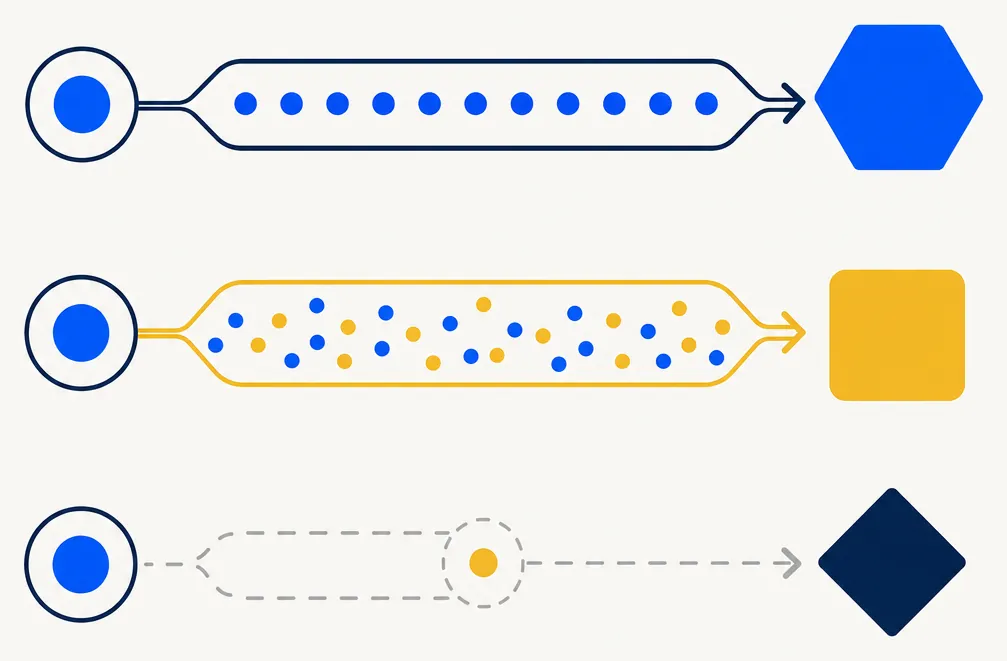
- Need cleaner benchmark exposure? That is beta.
- Need more tax-lot surface area? That is long.
- Need a more advanced overlay or a way to offset risk without selling appreciated longs? That is where short may enter the conversation.
That framing makes product design clearer too. Beta is about simple exposure. Long is about tax-aware lot management. Short is about advanced overlay behavior and should be gated accordingly.
If you want the rules behind the sleeves, read Beta, in plain English, The wash-sale rule, demystified, and Why big firms want you in their TLH program.